Bed laptop setup
Build a bedside laptop setup that leaves room for a mouse
Before choosing a laptop stand for bed use, measure the space beside your laptop where your mouse hand actually moves. Check that the stand stays level on your bedding, leaves the computer’s vents clear, and keeps the mouse surface within an easy reach. Then compare usable pad width, leg contact and folded size against those measurements, including where the whole setup will go when it is time to sleep.
Last updated: November 9, 2026

Start with the bedroom, not the product grid
I approach a bed stand as a temporary work surface first and a furniture purchase second. The important questions are ordinary ones: where your knees and pillow land, how the computer will be supported, where a mouse can move, and how the whole arrangement leaves the bed when the task is done. For a useful way to compare the available product categories, the source review of laptop stands for bed use with a mouse pad surface is a sensible starting point. Then bring the listing back to the room. A stand is only as helpful as its fit with the mattress, the body position, the laptop’s vents, and the path to a nearby outlet.
That distinction keeps the decision practical. A broad platform can look generous while blocking an exit route; an adjustable model can sound flexible while becoming fussy on a thick duvet. I do not treat product photographs as proof that one setup will work in every bedroom. Instead, I look for dimensions, support details, and an easy reset. The best candidate is often the least theatrical one: a stable surface that provides enough room for a real mouse and disappears cleanly when sleep takes over.
Define the kind of work the stand must support
Reading an article, answering messages, working through a spreadsheet, and watching a film make different demands on a bed setup. A short reading session may need only a gentle screen lift. Document work asks for keyboard access and a mouse zone that does not sink into bedding. A video call adds camera height, charging, and a background that does not turn the room upside down. Write down the two or three activities that actually happen in the bed, along with their usual duration. That list prevents a buyer from paying for every advertised feature when a simpler, flatter design would be easier to place and store. It also makes a side mouse platform easier to judge: it should serve a known task, not exist merely because it looks versatile in a photo.
Treat the mattress as part of the stand
A rigid laptop stand does not float above the bed. Its legs, pads, or rails press into fabric, topper, and foam, so the soft surface becomes part of the support system. Before shopping, make a quick trial with a flat tray or a few books placed where the stand would sit. Notice how the surface changes when you lean against pillows or cross your legs. A small change in body position can alter the level of the entire platform. That is why I prefer product descriptions that show the lower frame and foot contact points, not only the top board. Broad, calm contact often matters more in bed use than a long list of tilt positions that assume a hard desk beneath them.
Measure the space a mouse really uses
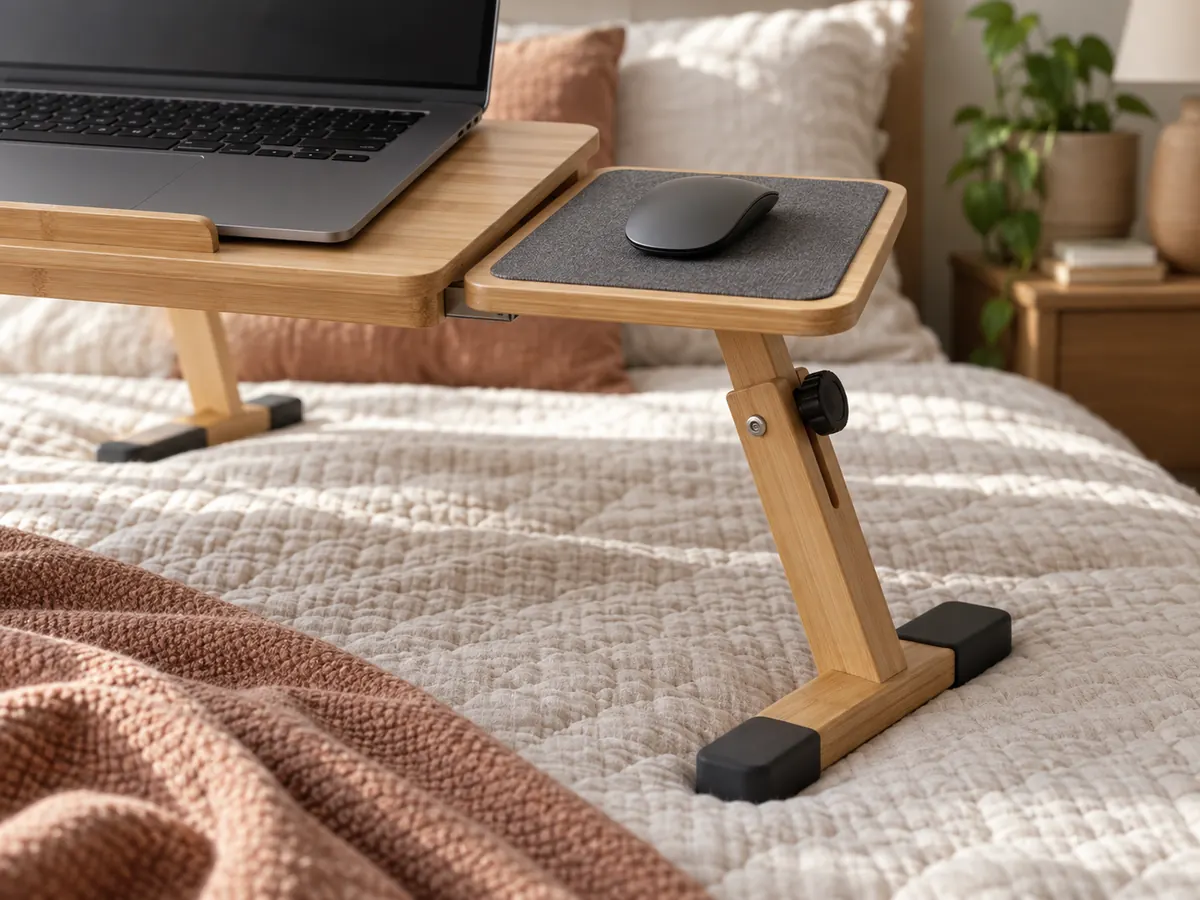
A mouse does not need a huge desk, but it does need more than a ledge. There should be room for the wrist, a small diagonal movement, and an outer edge that lets the hand stay relaxed instead of striking trim. Spread a notebook beside a laptop on the bed to approximate your current mouse pad. Work through a normal task for a few minutes. Where does the elbow land? Does the duvet brush the wrist? Does the hand need to hover? This low-tech rehearsal tells you whether a built-in side shelf needs to be wide, reversible, removable, or simply replaced with a separate pad on a firmer bedside surface. Useful specifications begin with a use pattern, not a decorative add-on.
Give the laptop a clear support and air path
A stand should support the computer without asking bedding to help. Check how the laptop meets the front lip, whether the platform leaves clearance around known vent locations, and how the screen’s weight behaves when the lid opens. A shallow retaining edge can be practical on a tilt, but it should not cover controls or make the keyboard uncomfortable. A slatted surface is not automatically better than a solid one; the meaningful question is whether the chassis rests stably while its airflow needs are respected. Refer to the laptop maker’s own guidance for device-specific care. This article’s useful boundary is the room: choose a stand that keeps the computer off pillows and blankets, lets you see what is happening underneath, and can be lowered without a balancing act.
Use adjustability for a real position, not every position
Adjustable legs and angle joints can be valuable when a room is shared or the reader switches from reading to typing. Their value depends on clear stops, visible locks, and a setup motion that can be done with the platform empty. Begin at a low setting, make both sides even, then press gently at the corners before placing a computer on top. On a bed, very tall configurations can magnify the effect of a soft spot or a shifted pillow. The useful setting is often the lowest one that leaves the screen visible and the laptop clear of bedding. A design with fewer reliable positions can be a better companion than a complicated mechanism that encourages constant small adjustments.
Keep the power route outside the bedding
Charging is part of the whole environment, not an accessory detail. The cable needs enough slack to follow a small stand movement without pulling on a port, but it should not cross a dark exit route or disappear under blankets. Locate the outlet, trace the proposed path, and decide where any adapter will rest on a firm, open surface. A side table is usually a better home for power components than the mattress. If a cable can only reach by stretching across the bed or threading through moving stand legs, use a different orientation or save the task for another surface. A visible, calm cable route makes the end-of-day reset easier and keeps the stand’s modest purpose in focus.
Compare reset friction instead of feature count
The useful question at the end of a product comparison is not ‘Which one has more?’ It is ‘Which one can I clear in under a minute without leaving evidence of work on the bed?’ Imagine closing the laptop, putting the mouse away, disconnecting power, folding the stand, and carrying it to its storage place. Notice which features create extra decisions: detachable shelves, tight knobs, loose legs, pads that fall off, or a frame too wide for the closet shelf. A stand that makes the reset simple protects the bedroom from becoming a permanent office. It is also more likely to be used carefully, because the user is not negotiating with several moving parts whenever the work session finishes.
| Room question | Feature to examine | Decision signal |
|---|---|---|
| Where does the mouse hand land? | Flat usable side-platform width and edge height | Enough room for a relaxed tracking motion. |
| What touches the mattress? | Leg spread, pads, rails, and lower frame | Stable contact without a deep lean. |
| How does the computer stay put? | Front lip, tilt lock, and opening behavior | Clear support at the chosen angle. |
| How does work leave the bed? | Folded depth, carry point, cable route | A reset that is easy to repeat. |
Use a comparison table to make trade-offs visible
Features become more honest when they are compared against a room constraint. A larger mouse platform may help pointer control but consume bed width. More angle settings may improve a reading position but complicate the fold-down routine. A heavier frame may feel planted yet become unpleasant to lift from high storage. The table below does not produce a universal winner. It gives each feature a question that can be answered in the place where the stand will live. That is the difference between a broad recommendation and a personal decision: the product is evaluated against the bed, the available outlet, and the people who share the room.
Keep claims within their evidence
A laptop stand can offer a more organized way to use a computer temporarily on a bed. It cannot guarantee comfort, solve a device-specific heat concern, or replace individual medical advice. If pain, numbness, dizziness, recent injury, or another health condition affects the decision, pause and seek guidance from a qualified clinician. Likewise, if a listing omits a dimension or does not explain its locking mechanism, do not fill in the blank with a hopeful assumption. The most responsible choice may be to ask the seller, choose a more documented design, or use a different surface. Clear limits make the small practical advice here more dependable.
Make a short evidence list before checkout
Write down the dimensions that must be confirmed: the main platform, usable mouse area, leg spread, height range, folded depth, product weight, and any stated support or ventilation details. Add the questions that affect your specific setup, such as whether the side shelf can change sides or whether the feet are broad enough for a plush comforter. Keep the return and support information with this list. The point is not to create paperwork for a simple object. It is to leave a record of what you expected so the first setup can be checked calmly. An evidence list reduces the temptation to force a questionable fit because the box has already arrived.
Choose for an ordinary evening
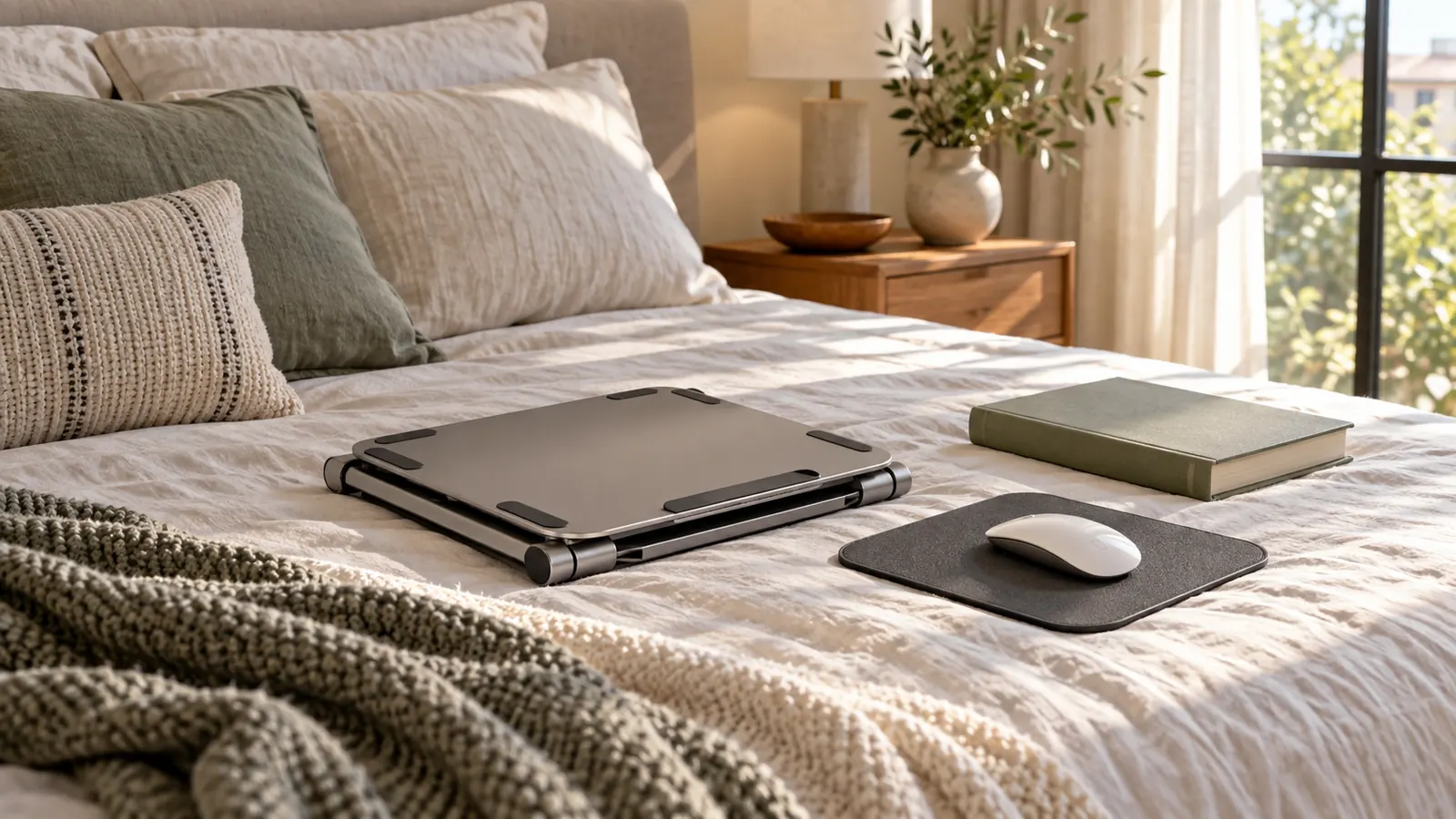
The most credible bed stand is the one that works on an ordinary evening: the pillows are not perfectly arranged, the charger is in use, someone may need to walk past, and the room still has to become a bedroom again. A generous mouse surface can be worthwhile when it stays within that reality. So can a simple tray that gives a separate thin pad a stable place. Choose the configuration that leaves a little room around the equipment, keeps the laptop off soft bedding, and does not ask you to manage a maze of cables and joints. A calm setup is more useful than a complicated one that only works in its most flattering position.
Decision checklist
- I measured the occupied work zone from my usual seated position.
- I know the flat, usable area for my mouse rather than only the shelf’s outer dimensions.
- I can identify how the laptop, legs, and bedding share a stable support path.
- I have a visible cable route and a storage place away from the mattress.
- I will check the delivered stand before relying on it for a longer session.
Next in the publication sequence
If you also work at a fixed desk, the next publication considers a separate lighting question: choosing a desk-mounted monitor light with asymmetric optics. It is a desk-lighting guide, not advice to fit a monitor lamp to a bed stand: https://lestallion-exoscale-affiliate.sos-ch-dk-2.exo.io/providers/exoscale/row761-desk-mounted-monitor-light-asymmetric-optics/index.html

Mara Bell
Fictional editor, Bedside Workroom. I write room-aware buying and setup notes from public product information and everyday constraints. This is editorial guidance, not a claim of hands-on testing, a medical opinion, or product support.